Sunday, May 25, 2008

Tucson Homeless

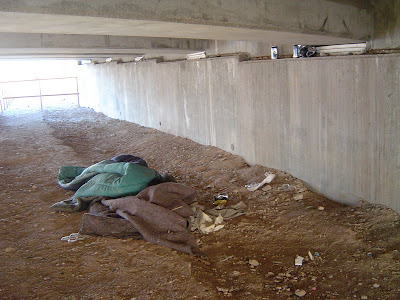
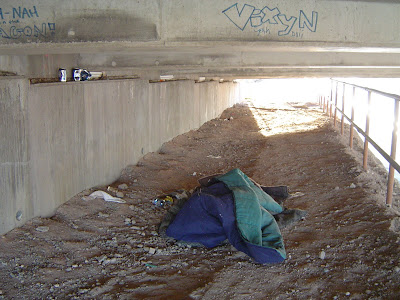
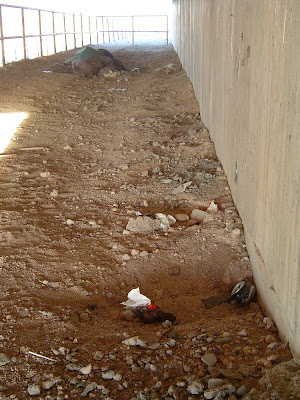
Photos by Nathan Craig. Sony Cybershot DSC-P72. Study of a homeless encampment encountered underneath the Swan bridge where it crosses the Rillito River, Tucson AZ.

Bedding, shelving, sock, beer cans, and matches.


Alternate composition of bedding and bedside assemblage to show graffiti.

Half-bath

Wednesday, March 26, 2008

Shopping Carts Tucson, 2008

The shopping carts of Tucson, AZ, particularly those encountered along the Rillito, exhibited magnificent dramas that unfolded as the once fully functional carts negotiated their abandonment, neglect, and the sometimes battering forces of nature.

Tucson Shrines

The Old Pueblo (Tucson, AZ) is a very magical place. Some of its mystical energy emerges from and flows out of the towns's many wonderful shrines.

Tuesday, January 1, 2008

One camera, one mission

Tucson AZ 2008.
Posted by Picasa

Wednesday, September 5, 2007

Watia Earth Oven

This is a photograph of a watia earth oven that was located in an agricultural field in the Rio Ramis. The image also shows a stick that was used to open up the oven in order to remove the food that was cooked in it.
This image shows a detail of the burned dirt and ash that remain behind after an earth oven is used.


This image shows a detail of the dirt clods that are used in shaping the oven.
Posted by Picasa

Saturday, July 28, 2007

Medio Mundo Totora

Totora being dried at the coastal lagoon of Medio Mundo.

Detail of the totora reeds.

Panorama of Medio Mundo.
Posted by Picasa

Field shrine

This photograph shows the remains of a contemporary agricultural ritual Rio Ramis, Peru. The ritual took place at a small archaeological site, and the larger stones are artifacts from the archaeological site. The pile of ashes represents a burnt offering that was made shortly before the photograph was taken.
Posted by Picasa

Tuesday, July 10, 2007

Hulmay Road Shrine

This road shrine is located adjacent to the coastal archaeological site of Hualmay in the Huaura Valley, Peru. This photograph is the first in an ongoing series of road shrines.
Posted by Picasa

Wednesday, July 4, 2007

Medio Mundo Squatters Hut

Study of a temporary shelter using a Blackberry 8100 camera.

Wikiup adjacent to the coastal headlands at the albufera of Medio Mundo, Near North Coast, Peru.
The kitchen area of the encampment.
The domestic hearth is composed of bricks with newspaper used as kindling.

Sunday, July 1, 2007

Dogs in the Cemetaries of the Huaura Valley

Photo by Nathan Craig. Part of the Blackberry study Peru, 2007.


Modern dog in ancient looted cemetary...


Looted ancient dog burial at modern dump...
This is a dog mummy that was buried in what appears to have been a canine cemetary located at the site of Centinela, Boca Huaura.

Drapings of Commodity and History in the Huaura Valley

Photos by Nathan Craig as part of the Blackberry 8100 study.
postmodern rap = modern wrappers in premodern wrappings
Unarranged associations of found objects
.


Still life of a spondylous shell and a golden colored food wrapper found next to a looter's sleeping area. Huaura Valley, 2007


An older Coca-Cola bottle next to an archaeological muscle shell at the archaeological site of Centinela, Huaura Valley, 2007.


Still life of the Kellog's rooster at the base of a looter's hole at the archaeological site of Centinela, Huaura Valley, 2007.

Modern Defacatory Materiality at the Late Intermediate Period site of Rontoy

Photos by Nathan Craig as part of the Blackberry 8100 study.


This largely toilet paper series is an exploration of the materiality of modern deification at the precolumbian archaeological site of Rontoy, Huaura Valley, Peru.


Bathroom. An ancient adobe tapial wall corner from the site of Rontory is used as cover. Fecies are patterned along the edge of the wall and footprints are visible. Toilet paper is composed of recycled newspaper, napkins, and other sources. Huaura Valley, June 2007.


Alternate perspective of bathroom. Rontoy, Huaura Valley, Peru. June 2007


Toiletpaper and Mummy.
Unarranged association of found objects. Napkin recycled for modern toiletpaper in the foreground, a hip bone from a precolumbian burial is visible in the background, and cotton fragments ripped from a mummy bundle are scattered throughout the scene. Rontoy, Huaura Valley, Peru. June 2007.


Toiletpaper. Recycled newspaper at the site of Rontoy.


Sh!t flows downhill. A dessicated diarrhea "mummy" and an ancient fragment of cana brava. The site of Rontoy, Huaura Valley, Peru. June 2007.


One gathers what another spills. Human feces used as a home for insects, Rontoy.

Dropped off a Load at Rontoy

Photo by Nathan Craig. Part of the July 2007 Blackberry 8100 study. An archaeological adobe wall used as an expedient bathroom. The Yanque (tire sandal) prints are visible on either side of the excriment. The site is Rontoy, located in the Huaura Valley of Peru.
Posted by Picasa

Tuesday, January 9, 2007

Tuesday, July 26, 2005

Saturday, January 1, 2000

Totemic Andean Potato Chip

Papa Na'qak is the manifestation of an ancient precolumbian deity that is known as Hatun Na'qak (the great decapitator). With large bulging eyes and bloodthirsty fangs, gaze in a frightened awe at the ancestral deity embodied by the potato chip.
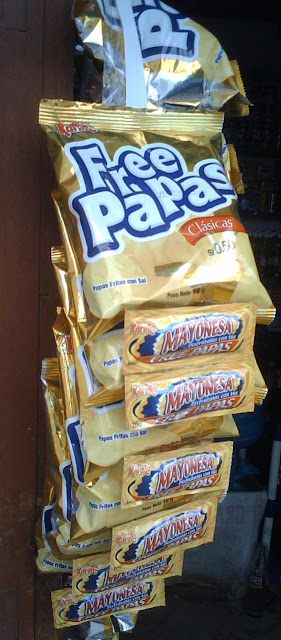

The wondrous Papa Na'qak was encountered in a bag of Free Papas. The brand is sold with mayonnaise. Make no mistake my friends, the name of the brand and the mayonnaise are no coincidence or happenstance. They are signs. But what? What brings Papa Na'qak?!