Saturday, August 23, 2008

Deformed Crania

Photo by Nathan Craig as part of the Huaura Valley Blackberry Perl study of 2007. Precolumbian child burial with deformed crania. Hair is still attached to the skull and fragments of skin can be seen clinging to the bone. Relatively fresh quids of coca can been seen in the upper right frame of the background. These quids were left by looters who were exploiting the site the night before. Looters will chew coca to protect themselves from mal aire (bad air) or antimonio (antimonium).
Posted by Picasa

Sunday, August 17, 2008

Shrine at Porvenir


Photo taken in 2003 by Margaret Brown Vega. Modern shrine made at the base of a Preceramic (ca. 3000 B.C.) mound at the archaeological site of Porvenir, in the Fortaleza Valley, Peru. Crania from a Late Intermediate Period (ca. A.D. 1000-1470) burial ground intruding into the preceramic site are gathered, along with pottery and other remains, and assembled. Dried coca leaves were left inside a heart-shaped tin and scattered over the assemblage. Activities at the shrine employed coca leaves, and alcohol, as evidenced by empty or partially-filled liquor bottles left behind. Hair from the once fresh crania lies scattered among the skulls, and pools of now-cooled candle wax blanket parts of the shrine.

Anthropomorphic black candle, slightly melted, placed among the items of the shrine. The candle has been pierced twice in the torso.

Plastic toy soldier placed in the shrine. Remains of a burned white candle drip down from above.


An image of a woman, burned, placed next to the heart-shaped tin. Upon further inspection I realized this was not a photograph, but a page from a magazine. The dark area to the right of the photo is black from exposure to fire.
Posted by Picasa

Shrine Etymology: Wikipedia

Shrine - Wikipedia, the free encyclopediaA shrine, from the Latin scrinium (‘box’; also used as a desk, like the French bureau) was originally a container, usually made of precious materials, used especially for a relic and often a cult image. By extension it has come to mean a holy or sacred place containing the reliquary or tomb dedicated to a particular hero, martyr, saint or similar figure of awe and respect. Shrines may be enclosures within temples, home altars, and sacred burial places. Secular meanings have developed by association, as noted below. A shrine at which offerings are made is called an altar.

Shrine Etymology: Oxford English Dictionary

Oxford English Dictionary shrine, n.
{dag}1. A box, coffer; a cabinet, chest. (Cf. SCRINE.)
In OE. and ME. applied to the ark of the covenant.

Quotations: c1000 ÆLFRIC Josh. iii. 8 {Th}a sacerdas, {th}a {th}e {th}æt scrin [Vulg. arcam] bera{edh}. c1000 Ags. Gosp. John xii. 6 For{th}am {th}e he wæs {th}eof & hæfde scrin [Vulg. loculos]. c1150 Voc. in Wr.-Wülcker 546/29 Archa, scrin. 1387 TREVISA Higden (Rolls) III. 109 {Th}e schryne of {th}e testament [arcam testamenti]. 1398 {emem} Barth. de P.R. XIII. ix. (Tollem. MS.), {Th}e schryne of oure lorde [ed. 1582, the Arke]. 1516 Burgh Rec. Edin. (1869) I. 161 Item, in the compertas of Craufurdis ane standand bed, and ane schryne. 1560 Stirling Burgh Rec. (1887) I. 75 Ane schryne but the lid. 1658 PHILLIPS, Shrine, a chest or cabinet.

Thursday, August 14, 2008

Arcmap rubbersheeting of Calapuja, Rio Ramis, Peru

Profile of a roadcut that was made through the main mound at the archaeological site of Calapuja.
Posted by Picasa

Autostitch mosaic of Aspero, Rio Supe, Peru

Panoramic aberation depicting the archaeological site of Aspero and the surrounding landscape of the Rio Supe, Peru.
Posted by Picasa

Monday, July 28, 2008

How many archaeologists does it take to photograph 1 square meter of dirt?


photomapping
Originally uploaded by n8craig
Luis Flores Blanco, Honorato Tacca, Albino Pilco Quispe, and Nathan Craig photomap an archaic lithic scatter in the Rio Ramis drainage of the Lake Titicaca Basin, Peru. 3 July 2008.

Friday, July 25, 2008

Mannequins of Puno

Photos by Nathan Craig. These photographs were taken in Puno Peru and they were taken with a Blackberry 8100 Perl. The mannequins were located in a series of shops located near the railroad station. The figurines were interesting both for their exaggerated and grotesque features, but also because they represented a distant departure from the way the people of this Andean region look.


Saturday, July 19, 2008

Vortex and Siente in context

Photo by Nathan Craig. Here at a Mira Flores branch of the chi-chi Peruvian market Plaza Vea, hybridity is manifest through commodity. Rows of Vortex and Sentiente, two energy drinks whose featured stimulants are Andean plants, can be seen on sale. Vortex is made with Coca while Sentiente is made with maca.


Maca is a highland plant that is supposed to be good for the kidneys and is said to improve male sexual potentency.
Posted by Picasa
Sold in major supermarket chain, Vortex coca energy drink: identity, comodity, and hybridity.
Posted by Picasa

Salchi Bites

Pizza Hut, Mira Flores, Lima Peru 2008.
Posted by Picasa

Sandwich Miguel, Mira Flores, Lima, Peru

Salchipapa super plato from Sandiwch Miguel next to Pizza Street off Parque Kenedy, Mira Flores, Lima Peru.
Posted by Picasa

Is archaeology a two way street?

Photo by Nathan Craig. Av. de la Arqueología is located next to the Mueso de la Nacion (the Museum of the Nation) in Lima, Peru. Multivalent and/or multivocal materiality.


Surveillance Cameras, Mira Flores, Lima, Peru July 2008

This surveillance camera was observed cantilevered from a window sill, located above a doorway on an older building, that was built next to Parque Kenedy, in the upscale neighborhood of Mira Flores

The series of photos illustrates the positioning of the camera and its larger context. In the first shot the mechanical eye tirelessly monitors a worker below who is repairing the street. The second shot shows additional detail of the lamp suspended below the camera. The third shot shows that the lamp consists of an aluminum roasting pan and a fluorescent bulb.


Thursday, July 17, 2008

Green Maize at Aspero

Aspero is an archaeological site that is located in the Supe Valley of Peru. The site has played an important role in the Maritime Foundations of Andean Civilization (MFAC) theory. Excavations of the site have revealed the presence of some maize. During the past few decades the town of Puerto Supe began using Aspero as the town dump and much of this important site was buried under trash. In 2005 Ruth Shady and Michael Moseley organized efforts to remove the trash from Aspero. The lion's share of the garbage was hauled away by trucks, but there are still remnant scatters of modern trash still found on the surface of the site. This green plastic fragment of maize represents one remnant fragment of this trash.
Posted by Picasa

Tuesday, July 15, 2008

Aspero Onion

A discarded onion found growing. The moisture this onion needs to survive is supplied by the heavy coastal fogs that come with the dense marine layer which is fueled by the cold Humboldt current. Huaca de los Sacrificios can be seen in the background.
Posted by Picasa

Friday, June 27, 2008

Payday at Calapuja

Photo by Randy Haas. 27 June 2008 Nathan Craig, right, pays Bitaliana for her work during excavations at Calapuja. The photograph is taken in front of Bitaliana's home.


Posted by Picasa

Bitaliana on Payday.

Photograph by Nathan Craig. 27 June 2008 Bitaliana stands next to several pieces of groundstone in front of one of the several rooms of her home. The soot stains on the windowsill on the left suggest that this structure is used for cooking. The smaller outbuilding is a chicken coup.
Posted by Picasa

Sunday, May 25, 2008

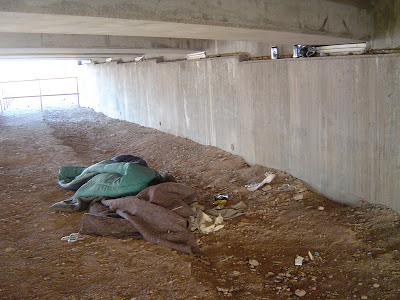
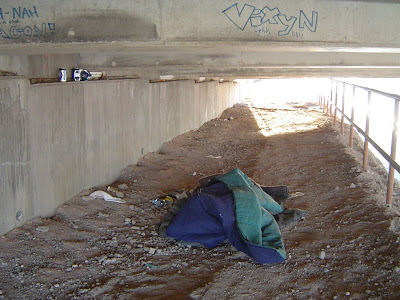
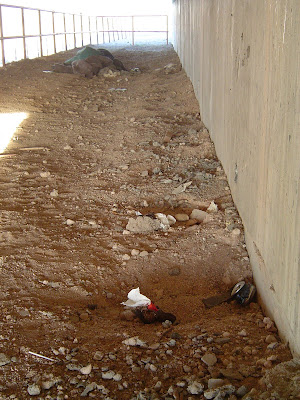
Tucson Homeless

Photos by Nathan Craig. Sony Cybershot DSC-P72. Study of a homeless encampment encountered underneath the Swan bridge where it crosses the Rillito River, Tucson AZ.

Bedding, shelving, sock, beer cans, and matches.


Alternate composition of bedding and bedside assemblage to show graffiti.

Half-bath

Wednesday, March 26, 2008

Shopping Carts Tucson, 2008

The shopping carts of Tucson, AZ, particularly those encountered along the Rillito, exhibited magnificent dramas that unfolded as the once fully functional carts negotiated their abandonment, neglect, and the sometimes battering forces of nature.

Tucson Shrines

The Old Pueblo (Tucson, AZ) is a very magical place. Some of its mystical energy emerges from and flows out of the towns's many wonderful shrines.